Placenames & Heritage

Introduction

Sources

Placenames: their value

Placenames: some aspects of their origins and usefulness

Placenames: cultural aspects

Categories of placenames

The Ordnance Survey placenames and the Wicklow Hills

Which are the correct names?

General aspects of placenames

Comments on specific placenames in the Wicklow uplands

Blackstairs - some thoughts on the possible origin of the name

Mount Leinster & Blackstairs - some notes on the main placenames found here

Bibliography and web links


Introduction

Here are some thoughts on placenames in the Dublin, Wicklow & Carlow/ Wexford uplands and how I have approached the task of deciding which names to show on our maps, where to place them and what forms to use.

I don’t claim to be an expert on language and placenames but I have a longstanding interest in the countryside and hills. I've always had an eye for landscape & topography and human cultural interaction, including the labels we apply to features of the landscape. Of course, like many others I learnt many names from the published Ordnance Survey maps – the One Inch Dublin & Wicklow sheets, the Half Inch Sheet 16 and the Geological Survey maps in B/W One Inch scale. As I rambled over the hills in the later 1970’s and early 80’s, I became aware of other ‘unmapped’ names through the writings of JB Malone and Liam Price. When I came to produce maps of Wicklow, I decided that I’d look up some of these ‘unmapped’ names and see about recording them. Thus I entered the labyrinthic world of placenames!

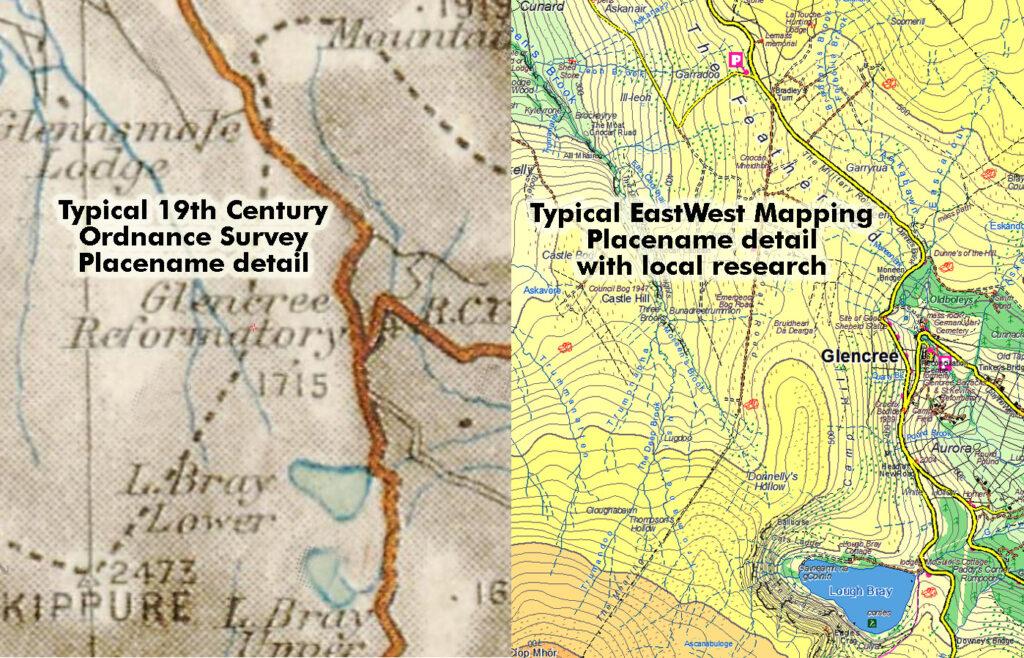
I haven’t published a name on our mapping without careful consideration of the main factors a) what form of the name to choose and b) where can I locate the name and to what type of feature. One does not exist properly without the other and one of the weaknesses of previous collections of placenames is that often we just have a list of names which whilst interesting, are somewhat lifeless without location. Apart from the study of historical sources as listed below for example, I believe that many useful conclusions also can be drawn both by consulting local people who have lived and worked on the hills and examining the landscape on the ground. All sorts of little aspects not readily apparent in a paper listing can then make sense. This is time consuming but rewarding work, I have met many people who have been both welcoming and helpful in terms of passing on what they know of their local placenames and for this I thank them. Please note that we do not receive any public funding for this type of research and it is done purely out of an interest in these matters and a desire to improve the record.

The classic definition of placenames on a map is along the lines that ‘Lettering should express by its style the nature of the feature, by its size the importance of the feature, by its placement the location, and by its spacing the extent of the feature'. Thus we have strived.

Sources:

  • The works of the Ordnance Survey in the 1840’s in the course of producing the Six Inch series and related mapping. These form many of the names we are familiar with as they were derived from the first countrywide systematic recording and presentation of placenames. See below for my analysis.
  • Maps that predate the work of the Ordnance Survey. There is a reasonable collection in the National Library of Ireland. The most notable relating to Wicklow is Jacob Nevill’s map of 1760 and derivatives. Many estate maps were produced in the 1700-1900 period for the landed gentry, for the purpose of managing rents and so on. Maps for Powerscourt & Ballinacor Estates for example, record many interesting names.
  • The works of Liam Price (1891-1967). I have leant heavily on Liam Price’s investigations – Liam was a district justice in Co.Wicklow in the early days of the new state. His career spanned from 1920 to 1950 and his job required him to be an early motorist as he travelled around the various courts in Baltinglass, Blessington, Wicklow and Arklow and so on. That was the day job but Liam’s ‘real work’ was in the collection of information on history, antiquities and placenames. Liam was a man for going to original sources and sought out hill farmers and rural country people, enquiring after sites and names. This information he recorded in a series of notebooks which in turn formed the basis for articles in various scholarly journals but he is best known for the seven small books, The Placenames of County Wicklow, which were published from 1945-67. His notebooks were published in 2002 in two volumes as The Liam Price Notebooks. Between these, there is a goldmine of information on such matters. Be warned though that the notebooks can be likened to a maze and you’ll as likely find information on a given place on the first page as the last! Notwithstanding that, there are many names recorded there that didn’t make the Placenames, perhaps Liam was uncertain of them or more likely, he forgot where he had written them years before! It should always be remembered that Liam had a walking impediment and whilst he undertook some hill walks which are recorded in his diaries, he probably wasn’t able for long days in the hills or rough ground. So whilst he visited many of the valleys and collected names in their vicinity, he wouldn’t have been necessarily familiar with the features lying above. He comments often enough, that you’d have to walk the hills to get the names.
  • J.B. Malone (1914-1990) who wrote The Open Road, Walking in Wicklow and a regular newspaper column in the Evening Herald, lists many placenames in his publications. JB was an active mountain walker and familiar with the hills. Doubtless he did get local names in his travels and passed same onto Price but on the whole I think it’s fair to say, he was familiar with Price’s work and drew many names from there.
  • Charles Thompson (C.G.Thompson) was a contemporary of Liam Price and worked as a science teacher for many years in Mountjoy School. Like Price, he was also an early motorist, travelled around Wicklow and liked to chat to local people about their areas. He had an interest in mountaineering and seems to have been an active mountain walker in Wicklow. He contributed many names to Price's work - particularly names related to the higher hill areas. This filled in a gap in the Price records as Price himself was less able for rough ground due to a leg injury.
  • The work of Fr.Pádraig McCarthy on placenames around Rathdrum and Glenmalure in which he lists many names, sourced from parish records, collected mostly by Fr.Richard Galvin in the post Famine period. These are fascinating as they were collected after the OS mapping but before C.G.Thompson and Liam Price.
  • Local people. There are many names in the above sources where it is difficult to establish location – i.e. people have written down lists of names they have been given but with little or no guidance as to where they refer to. This particularly applied to the Glenmalure area and I was fortunate to be referred to Carmel O’Toole whom I asked for help in locating some of these names. Carmel talked to a few neighbours in the valley about the old names and I was very pleasantly surprised to meet them and find out that many of the names were still known, if little used nowadays. Furthermore they had names which did not appear in any of the above sources. This set me off on a journey around the Wicklow valleys and with the help of the Wicklow Uplands Council in identifying suitable people and other referrals etc., I met up with circa thirty people over the space of a few weeks – mostly hill farmers who would have been up on the hills over the years looking for sheep etc. This was a great help in confirming names that were still known, establishing some obsolete names and collecting c.160 ‘new’ names for various features. On the whole, these enquiries were received with interest and a desire to have some of the local names recorded and kept in use. Of course, I was often told – ‘You should have come 5,10,15 years ago – so and so had all those names’ but even in 2010, I am glad to report that there are still people who have a working knowledge of many hill names.
  • Mount Leinster, Blackstairs and The Barrow Valley. The principal written sources I've referred to are the writings of (1) Patrick Kennedy (1801-1875): Legends of Mount Leinster, Evenings in the Duffrey & The Banks of the Boro (2) Michael Conry: Carlow Granite (3) Rathnure & Killane: a Local History 1798-1998 edited by Gloria Binions (4) The O'Leary Footprint edited by Philip Murphy & David Hughes (5) John Joyce: Graiguenamanagh A Varied Heritage & A Town And It's People (6) various local history booklets and pamphlets. A lot of information was collected directly in the field.
  • This research is ongoing and I will gladly receive any information on local names. If you know of anybody living in the greater Dublin & Wicklow area that having lived and worked in these area has a knowledge of local names, I'd be glad to visit, chat with and record what they can point out.

The names appearing on these maps should not be regarded as fully definitive – hopefully they are a better representation than that which has appeared heretofore but there is always scope for improvement. In particular, there are many names in the above historical sources which I have been unable to locate but which further research might clarify. There may well be other lists of names collected by people over the years lying in various attics or collections - please keep this in mind if you ever hear of anything like this, often a small piece of information is the key to solving these mysteries. See below for bibliography and links.

Placenames: their value

Placenames are the labels we apply to the features and divisions of the landscape which we inhabit and visit. Like language, they change over time but there is a thread of continuity in many placenames that connect us back to the previous generations that also gazed at and toiled on the same landscape. It is a matter of courtesy and also of practical benefit to be familiar with the placenames both of where we live and also those regions that we visit regularly for recreation. We give these labels to the landscape for various reasons but primarily concerned with ownership, description/ directions and in connection with farming. We like to describe our hillwalks now in terms of a series of features with names and in the past hills and saddles had names connected with giving guidance to travellers – ‘you keep this side of that bump, Creagard – follow the Blind Brook and pass over The Black Banks’ etc. Those working the hills, keeping an eye on their sheep and those of their neighbours, had a network of names describing brooks, hollows, rocks, grazing spots etc. It is worth mentioning in the context of this latter aspect that most hill farmers would know, say Aughavannagh Mountain as the side slopes of the hill where sheep would be, rather than as a name of a summit as in Aughavannagh Mountain top.

Placenames: some aspects of their origins and usefulness

  1. Probably the most common theme in placenames are references to local topography. Examples: Monroe from Móin Ruadh - the bog with a reddish/brown tinge and Lugmore from An Log Mór - the big hollow. There are many nuances in such names and as they generally reflect the nature of the ground locally, they are of considerable interest and relevance to route planning. If you plan to ascend Knockgorragh, you may expect the terrain to be a bit rough underfoot from the root word, garbh. Take into account that a good number of the Irish root words can come from 'old Irish' and/or might have slightly different meanings to modern Irish e.g. Madra would generally be taken now as meaning a dog but in older forms madra meant a wolf or perhaps a fox, wheras madadh was a dog.
  2. Manmade infrastructure is often found in placenames - churches, castles, bridges, fords, raths, mills. Examples: Kilbride from Cill Bhríde or Church of St.Bridget, Donard from Dún Ard or the high fort, Knockadreet from Cnoc a'Droichid or hill of the bridge.
  3. Many placenames include a family name - the people who owned and/or farmed particular land. Examples: Ballydonnell from Baile Dhónaill, Donal's place or perhaps from a family name, the MacDonnell. Castletoole from a compound name - castle here referring to a rocky tor and Toole to the O'Toole clan.
  4. Legends and pishogues feature in names. Fairies, spirits etc. Examples: Poulaphouca from Poll an Phúca or the hole of the watersprite, referring to the gorge and falls here lost in the creation of the reservoir. Knockshee or hill of the faeries etc.
  5. Historic events can be recorded in placenames. Example: Mullycagh from Mullach Catha or hill of the battle.

Placenames: cultural aspects

Placenames reflect the history, culture and language of an area over a long period of time. The east coast of Ireland and Wicklow in particular has experienced a tumultuous history over many centuries. Waves of invasion & plantation have left their imprint on the local names and to get a grasp of the names you must keep an eye on the history of the region. It's fair to say that the placenames of the eastern region are far more complex in origin because of these transitions than those of the west. Whilst many names have an Irish language root, there are also a variety of other elements to be found, broadly as follows:

  1. 'Old Irish' names, predating Christian times and the Vikings. These are difficult to identify as there are very few written records from these times. A few have been identified like Imaal from the tribe of the Uí Máil, Bre or Brea for Bray and Unry for Abhainn Righe, King's River.
  2. Early church and ecclesiastical names. The church kept written records in relation to administration and territories etc. Names like Reefert in Glendalough, Kilpipe, Kilmacanogue, Hollywood or Sancta Bosca etc. all relate and can date from the 5th century onwards.
  3. Vikings. The Vikings from Scandanavia came raiding along the Wicklow coast and inland via the valleys in the 8th century. Leaving aside the pillaging and plundering, some also settled and fished/ farmed. Names like Wicklow and Arklow come from this period. Wicklow is from Vikingr Lo or the river meadow/swamp of the Vikings, presumably the area we know as the Murrough.
  4. Old English/ Norman names. Dermot MacMurrough lost his kingdom of Leinster in 1166, looked for help from King Henry of England, who in turn referred him to the Normans led by Strongbow. The Norman force came shortly after, restored Dermot but also took significant holdings of land in return. The resulting Anglo Norman settlement extended through many parts of Wicklow, they were more organised in terms of charting their new territories adapting old names but introducing many new placenames. Examples: Blakestown, Davidstown, Curtlestown.
  5. Irish names. The O'Byrne, O'Toole's and others move into Wicklow from the Kildare side in the 1200's. At first they live peacefully under the Anglo Norman regime but gradually turn to war. By the 1300's, they largely supplant the Anglo Norman settlers in the upland and mountain areas. Again the placenames morph - these new settlers speak Irish but are familiar with the Norman names so they keep some, gaelicise others and make new placenames in Irish. Examples: Walterstown became Ballyvaltron, Simonswood became Kiltimon. Many of the names with an Irish root, later anglicised come from this period - like Lugageeraun or Glendalough etc.
  6. Plantation names. The Anglo Norman influence gradually waned in Wicklow and Ireland generally but the English re established their control in the 17th and 18th centuries with several plantations (ethnic cleansing). The lowland coast strip was well enough controlled up till the 1798 rebellion and for a period of time thereafter, whilst the hills were the base of significant Irish rebel groups who raided the estate lands lower down. This led to the construction of the Military Road and barracks in the early 1800's. Many large estates were created in this period by seizing land and setting up tenants who paid rents etc. to landlords. Of course, the new gentry liked to fashion new names as well, so we have Ashford, Charlesland, Downshire etc.
  7. 'Modern' English names. These fall into two broad categories (a) those associated with local people, mostly English speaking since perhaps the 1700’s. So we have names like The Rushy Brook or The Green Hollows, the latter a place where there’d be better grazing for sheep amongst the heather and bog. (b) those associated with recent settlement, housing estates etc. – marketing names like Silvercross or Glendale etc., usually relatively meaningless in terms of local history or topography and more to do with sales & marketing. Some new names like Parnell Park etc. will have a local connection.
  8. Modern Irish names. Although Irish has not been widely spoken in Wicklow for 200-300 years, I observe that there is a growing practice to make up an Irish name even where a perfectly good one exists from another culture, for no better reason than it is believed that there should be an Irish form. So we have An Bhó Dhearg for Redcow or Áth na Fuinseoige for Ashford which are of course just literal translations and have no historical merit. There are modern Irish names used in housing developments and so on that do have some local relevance e.g. Cois Cairn

Categories of placenames

We give labels to the landscape for various reasons but there are two broad categories (1) names for administrative and legal purposes and (2) names of physical features in the landscape. There is of course often considerable overlap, so Glendalough describes the two lakes in the valley as well as being used for administrative purposes. Whereas a name like The Shiny Flags is related to a specific place where water glistens on rocks.

Administrative names in order of size might be (a) state (b) province (c) county (d) barony (e) parish (f) townland (g) sub townland (h) field. In general each is a subdivision of the former: so many fields make up a townland, so many townlands a parish or barony, so many baronies a county etc. The second observation worth making is that names tend to be well known and stable on the higher side of the hierarchy but as you progress down into townland and in particular field names, you will find more local variation and multiple names.

The other factor affecting permanence is that the further you look back in time, the more variation in names will be found. The reason is simple, just like language; placenames were and are transferred aurally, particularly local names. Prior to the 1800’s, records of placenames are generally found in administrative and legal documents relating to land ownership and territorial claims of church and state. Sound recording had not been invented, so we don't know what the everyday names sounded like. The great six inch survey of Ireland in the 1840’s was the first detailed mapping to document the names of the countryside on a national basis. As in the oft quoted opinion of the victors getting to write the history, so the versions of the names recorded and set down by the Ordnance Survey at this time have become the de facto official versions in most cases, regardless of their accuracy or completeness. There is a move in recent years towards standardised versions of names, not least to meet the requirements of digital processing, which does not cope well with variations in spelling – a local postman may be able to recognise Moanroe & Moonroo as the same place but a computer controlled letter sorting machine will not take to it. The Placenames Commission has been instructed to standardise placenames in this regard. Personally, I regard this is a loss – there is considerable cultural value in the many and varied local versions of some names.

The Ordnance Survey placenames and the Uplands

Prior to the six inch survey of Ireland, there were various regional, county and local estate maps of varying quality. The most notable perhaps relating to Wicklow is Jacob Nevill’s map of County Wicklow of 1760 and derivatives. The Ordnance Survey was set up in London in 1791 for the purpose of producing military maps. It was given the task of mapping Ireland in 1824 and set about planning & implementing this great task over the next decade. A framework of accurately measured points had to be established – a triangulation network, the apexes of which are the familiar triangulation pillars seen on many hilltops. The angles of the great triangles were measured by an instrument called a theodolite. Scale was provided by measuring one triangle side, very accurately by means of bars set end to end. Trigonometry was then used to calculate the co-ordinates of each trig pillar. This was completed by 1832 and these then formed the basis of smaller local triangles and finally ground survey to map in the detail. This work was largely undertaken in the late 1830’s and published over the following decade as the six inch and one inch sheets etc. The ground survey was by teams of survey sappers measuring with chains, plane tabling etc. Placenames were recorded as the survey teams progressed over the landscape. It was a phenomenal physical as well as technical achievement of its day – each field had to be walked and measured, whether on flat easy land or rough, rocky steep hill terrain. A remarkable degree of accuracy was achieved considering the very basic technology available. I have great respect for the efforts involved – the very opposite in many ways to modern topographic mapping which relies on imagery and remote sensing etc.

There are two factors worthy of consideration in relation to placenames on Ordnance Survey mapping and which indicate why, in terms of upland names we should cast a cold questioning eye on same:

  • The primary areas of interest to the survey were urban areas and rural arable land. The survey was for means of public administration and taxation etc. Mountain land then, as now was regarded as somewhat worthless. A glance at any six inch sheet abutting the hills will show considerable detail in the valleys but great blank spaces on the open mountain land, generally that above 1000 feet in altitude. Little work was done up high, except for the purposes of triangulation measurements. It is therefore reasonable to assume that little effort was made to collect names in the uplands. The view of the day is illustrated in the following quote from The Ordnance Survey Letters: Wicklow, page 2, where Eugene Curry writes on 13th December 1838 that ‘The fineness of this day induced me to visit Lough Bray and its stupendous cliffs and wild mountain scenery. To the sportsman, the geologist, or the artist, this might afford a pleasing enough excursion but the Antiquary finds nothing there but rocks, cliffs, waters and bogs, as old, and apparently as untouched by the fashioning hand of man, as the foundations of the earth. I was not able to ascend the top of Kippure Mountain over which the boundary line of Dublin and Wicklow runs, on account of the heavy mist that enveloped it, but as far as my enquiry goes it contains nothing of antiquarian interest.’ This is from a team of scholars, Eugene Curry, John O’Donovan and Thomas O’Conor who were tasked with investigating the sites and placenames of Wicklow in this instance and advising George Petrie of the OS as to the correct portrayal of names on the new mapping. Curry’s view would not have been untypical of the day and was illustrated frequently in line drawings of the times showing the mountains to be fiercesome and dangerous places. These three gentlemen were given about four months in the depths of winter in 1838/39 to cover the entire county! As might be guessed they concentrated on the main towns, villages and sites of antiquarian interest. One may presume that the upland areas, particularly in the bleak mid winter, held little interest for them.
  • The field surveyors were largely collected from British army ranks, presumably supplemented with Irish labourers. It is reasonable to assume that those tasked with writing and recording placenames were literate members, probably officers of the army. They had two ‘problems’ a) they were dealing with local Irish people who had strong local accents. Whilst Irish was probably not widely spoken as an everyday language at this time, the placenames having an Irish root and learnt aurally were doubtless pronounced ‘as Gaeilge’ or close to it, still are in many cases. Various conventions were applied to anglicise these names i.e. to write down some ‘English’ form of the Irish name. How well this was achieved must have been purely down to the diligence of individual interviewers. This writer having collected names from various hill farmers in recent years, having knowledge of local idiom and a working knowledge of Irish, found it a very subjective matter to try and capture in writing some placenames. The sounds can be elusive and change even when repeated. How well your average British army officer managed can only be conjectured. b) they were working at a time when placenames were more fluid, less fixed as they were generally not written down. Different local people might well have had differing names for the same site; farmers in different valleys might well have had different names for the same common features and so. Again, we can only conjecture as to how thoroughly names were investigated at the time and perhaps it is just happenstance that one particular form of name is the official name now, according to whom the survey party met on the day.

These factors are well illustrated in the various sources like Price quoted above where multiple forms of names were collected at a later date. In some instances names printed on OS maps are unknown to local people. Barnacullian in Wicklow is a good example. Price enquired after it in the 1920’s-40’s and found no knowledge of it in nearby valleys. I enquired in 2010 and whilst it was known as a ‘map name’ to some hill farmers, it wasn’t a name they said they’d have used in everyday work. There is a name Barnacuilloge known somewhere in that area which could be another form of same.

Which are the correct names?

People get attached to certain spellings or forms of names. They'll argue over and get annoyed about whether it should be Shroughan, Shraughan, Shroughawn, Sruhan etc., which is a pointless exercise as they are all essentially versions of the one name, sruthán - a small stream. However we can't go back in time and it is extremely unlikely that Irish will ever be spoken again as a main language in Wicklow. The anglicised forms are part of the cultural fabric and with mutations, the original forms are often uncertain. When deciding what names should be used, the names on the Ordnance Survey records are a starting point but I believe that careful consideration also needs to be given to the names recorded on older maps, the lists of names collected by Price, Galvin and others. Above all, perhaps consideration has to be given to the local people who have lived and/or farmed in these hills for many years. If anybody knows the ‘correct’ names insofar as they can be known, it is these people.

But that raises the issue of what should be regarded as ‘correct’. Is it the official form, perhaps as originally recorded by the Ordnance Survey and validated by the Placenames Commission along with an Irish translation? Is it an historical form of the name or that collected on the ground which makes more sense? Or perhaps a modern name adapted by hillwalkers in the absence of a name and /or knowledge of the local version? The hill top, Mullaghcleevaun East is known locally by hill farmers both in Glenmacanass and Glenbride as ‘Stony Hill’ or ‘Stony Top’, a reference to the boulders and rock strewn around the summit in a landscape otherwise of blanket bog. If you were to do a plebiscite, you’d find the vast majority of people who might have a name for that spot would know it as Mullaghcleevaun East from the OS map, yet that name has all the hallmarks of a ‘bureaucrat’ who didn’t know the name and just added East to the name of the main summit. Whereas the name Stony Hill has the ring of authenticity but the point is that very few know it by that name – so which is ‘correct’? Placenames also change, even locally, over time. Should we use the old forms of the name or the ones in current use? Glenmacnass is another good example: many people would know this form of the name from the OS and I’ve seen it loosely translated in the past as the ‘glen of the son of somebody’. However, the local form of the name is still Glenmacanass or Glenm(i)canass and this is as found on Nevill’s 1760 map. Furthermore, older documents again show it as Loganas and Glenlugganas – the Log an Eas is the hollow of the glacial valley at the base of the waterfall. So, an original form was likely Gleann Log an Eas – the glen of the hollow of the waterfall. Again which is ‘correct’ – the likely original form, the corrupted but related form as still used by locals or the further corrupted OS form which is the most widely known?


Nevill 1760

General aspects of placenames, particularly in relation to upland names in Wicklow, Wexford & Carlow:

Barna – Ballina – Boleyna
Barna in a placename is tricky as it can derive either from the Irish word Bearna - a gap or pass or from Barr na – the height or summit of something. The location of the name must be looked at - the name Barnaweelyeen or Barnaweenyeen is known for area on the upper west side of Glenmacanass and almost certainly comes from Bearna as there is a significant low point on the ridge here between Tonelagee and Mullaghcleevaun. Whereas Barnagoneen is an older form of the OS name Ballinagoneen. Barnagoneen would appear to be from Barr na gCoinín – the height of the rabbits. Ballina or Bally or Bal all come the Irish word, Baile meaning variously a place where people live or own, a settlement sometimes or just an individual house or even just a place someone farms. Boley comes from Buaile – usually a high place, up away from the main habitations, where livestock would be brought in summer for grazing. The three forms of this prefix can sometimes be found in various forms of the same name e.g. Ballyboy, Boleynaboy – maybe the locals called it the latter but the OS surveyor just assumed it was Bally when writing down the name – ‘sure they all sound the same’ etc.!!

Leoh
This is a peculiar word and I think it may have some significance in Wicklow. It possibly derives from the word Lágh or Lágha. It appears in Luggala, Log an Lágh – hollow or coum of the hill and has in the past taken to be an Anglo Saxon term for a hill – there are hills in Scotland and North England called Law or Low. However, others dispute this interpretation in Ireland. If it does come from this root and depending on how lágh was originally pronounced – it might help to explain the term Lo, Leoh, Lyoh etc. that also appear in Wicklow. The pronunciation that I have heard might be anglicised as Lyoh - Leeyoh, two syllables, emphasis on first, tongue rolled around the mouth. Lo has also been explained as a marshy place where mallows grow but that seems unlikely in terms of the places where the name applies. In Glendalough – we have the Glenealo valley, the valley above the Upper Lake, past the mines – two forms of this name collected in early 1900’s are Glanalagh and Glanaslagh. The latter could well come from Gleann Eas Lágh – glen of the waterfall of the hill, which would fit the site well as we have the waterfall there. The name Leoh or Lo occurs in particular in the Glenmalure & Glen Imaal area – Leohard is the local name for the OS Clohernagh, Lobawn is over near Donard. If there is a connection that explains these places well – the high hill, the fair hill etc. and is more likely that the marsh mallow explanation.

Lyre
Lyre occurs quite commonly as a local name. It comes from the Irish word Ladhar - a toe or tine (of fork), but in placenames it generally refers to a slanty outcrop of rock or a rocky gully perhaps. Walk up along the Miner's Road by the upper lake in Glendalough and loop across at the Spinc, you'll see lines of slanting gullies and rocky ribs - these are Lyres. So we have Lyreavea - the lyre of the birch probably, Lyreanuisce - lyre with water in it, the Split Stone Lyre, which I'm fairly sure is named after the obvious boulder on the Spinc ridge which has been split by frost action and lies at the head of the lyre.

Cor
In Wicklow often comes from the word Carraig/ Corrig – a rock. Cornagreine/ Cornagrainya/ Corrigreine etc. all coming from Carraig na nGréine – the sunny rock. Cornamadra from Carraig na Madra – rock of the wolf or fox.

Ban – Bawn
Ban or bawn in a placename needs consideration – it either derives from the Irish word Bán – white, but in case of hills, perhaps a pale or fair colour to the land, maybe grassy etc. However Bán is also an old word for a field or pasture and Bánóg is a small field. You need to look at the local context to see which might apply. Examples : Lobawn – probably the fair coloured hill, Slievenabawnoge – probably the hill of the small field(s).

Eas – Easca/ Aska – Eiscín/ Askin
All similar sounds found mixed up in hill placenames and all connected with water. Eas is a waterfall as in Pollanass, Poll an Eas – the hole of the waterfall. Easca often anglicised as Aska is a marsh, Askavore or Easca Mhór – the big marshy place. Eiscín often anglicised as Askinna or Askna seems to be a bog stream, a minor rivulet running through marshy ground. Askinbawn, Eiscín Bhán – bog stream of the field or perhaps running white when in flood etc.

Troman
The word Troman or Tromán is common enough in Wicklow and is associated with mountain streams. The word is also used for dwarf elder bushes but I don’t think there is a connection here as mountain streams are not the typical habitat of elder. Sometimes a small stream is just called Troman, in other cases there is an adjective as in Tromawnabrack – Tromán Breac, the speckled mountain stream perhaps a reference to the colour of the water and rocks or pebbles in same. The word Brook is also widely given for the same feature but is of more ‘recent’ origin – perhaps 1800’s on. 

Augh / Agh

Augh or Agh in a placename is generally thought to come from one of three sources, depending on the situation of the name: Áth - a ford, Achadh - a field or Each - a horse.

However along the slopes of Blackstairs Mountain and White Mountain and adjoining districts, it is clear that there are many water features associated with the prefix Augh. Going by convention you'd think that they refer to fords, so Aughnagappull below may well come from Áth na gCapaill, ford of the horses. However the large number of such names and nature of the qualifiers in other examples, lead one to conclude that Augh or Agh in this area signifies a stream, usually a mountain stream and perhaps equivalent to Sruth in other parts. So Aughsollagh is the muddy stream and Aughavay, the stream of the birch trees etc. The term Augh here may be related to 'abh' or 'abha', pronouncd 'aw' and 'ow' respectively, a river.

I've enquired with local people as to understanding of the name with no definitive proof to date. I've heard it usually pronounced as in Augh - Ach but also as Auk, as in the bird. A local history guide to Killanne and Rathnure gives 'Augh na Daragh i.e. streamlet of the oaks'. Here's a list of water features where the prefix Augh/ Agh applies in this region.

Augh, Augh an Uisce, Aughabriska, Aughabeag, Aughavay, Aughnaglaur, Aghnaglear, Aughawadda, Augh na Daragh, Aughnagappull, Aughteigmore, Aughcarrigeen, Aughnaclappa, Aughsollagh, Aughnagassee, Aughanana, Aughnacrue, Aughavaud, Aughafada.

If this is an alternative interpretation of the prefix Augh or Agh, then one has to consider if it applies elsewhere, particularly in the east. It might throw a different light on names such as Aughavannagh, Aughavourk, Aghleitrim, Aghfarrell etc.

Inch
Inch occurs frequently as a field name. An Inch or Inse is a river meadow, I suppose a place liable to flood. Inchavore, Inse Mhór – the big river meadow.

Kyle or Kil
Well known conundrum; arising from anglicising of the Irish word, Cill for a church or Coill for a wood. The original meaning can be guessed at by establishing if there were or are ecclesiastical remains in the area and second part of name is a personal or family name – hence Kilbride is from Cill Bhríde – Bridget’s church. If above meaning is not likely, then likely to derive from a wood – hence Kilmore from An Choill Mhór – the big wood. Woods are obviously very common features of the landscape hence you’d think that names with Kil, Kill or Kyle would predominately come from that source but there was a significant wave of early ‘hermits’ and saints following on from St.Patrick, who came across from Wales and Britain and set up small churches along the east coast of Ireland.

Scarr
Seems to come from the word Sceir, meaning a rock. The best guide perhaps is the reference in the Wicklow OSI Letters, where the broken steep rocky ground at the back of the Lough Brays are called the Scarrs. Likewise in West Wicklow we have the Scarrs of Lyragh, the same sort of broken rocky terrain. In relation to the mountain known as Scarr near Lough Dan, I think the name probably comes from this type of terrain found on the west side of the hill above Glenmacanass. See below re Kanturch which may be an older name for the hill.

Comments on specific placenames in the Wicklow uplands:

Lugnaquilla
Lugnaquilla is thought to come from either Log na Coille – the hollow of the wood or Log na gCoileach – the hollow of the cock (grouse). The former is thought more likely nowadays but either way the hollow referred to is most likely the great gash of the North Prison. There are three hollows or coums on Lugnaquilla and the North Prison is the most striking, particularly from the Imaal side which was settled in ancient times. The other coums appear to be Lugcoolmeen for the South Prison (Price thought this the east ridge towards Leohard – Clohernagh, but locals in Glenmalure place this name in South Prison area) and Lugueer for the hollow above the Fraughan Rock Glen. However when viewed from afar, particularly Kildare and Carlow etc., these coums are not apparent. What is easily observed though is the great relative height of Lugnaquilla – it is the highest point in Ireland outside of Kerry. One would expect a name more in keeping with this perhaps prefixed by Ard, Sliabh, Croaghan, Mullagh etc. However Lugnaquilla is recorded as a name in that area on Nevill’s map of 1760 and there doesn’t seem to be any modern tradition of any other name other than Lug. There is however a possibility that an older name may be preserved in the name, Baravore of Glenmalure. This is recorded as Bollyvorrevore in 1639 and Bollyvorewore in 1664, likely coming from Buaile an Bhairr Mhóir – the booley (see above) of the great height. The boundaries of Baravore townland extend from the floor of Glenmalure at Baravore ford, right up through the Fraughaun Rock glen to the summit ridge of Lugnaquilla. The booley could have been in the valley floor of Glenmalure and the ‘great height’ could refer to the steep sided glen but it could equally have been in what we call the Fraughaun Rock glen now, either above or below the waterfall, probably below as that's where the better grazing would be. If the booley was in either of these locations, the logic would have to be that the Barr Mhór is the 'great height' of Lugnaquilla which hangs above this valley. So perhaps an old name for Lugnaquilla is An Barr Mhór – simply the great height.


The Log na Coille or North Prison of Lugnaquilla? Viewed from Imaal.

Table Mountain
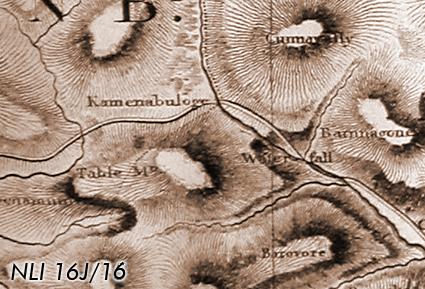
Where is Table Mountain? The OS have it north of the pass through which Table Track or The Stony Road passes from Glenmalure to Glen Imaal - a very ancient route. They mark it as the highest point of that slight rise crowned with peat hags. Table Mountain is also a townland extending to the west and downhill to where you would enter the military lands. Nevill (1760) has Table Mtn. south of the pass. There are some puzzling aspects to this. Firstly Nevill labels Kamenabuloge approx. where this pass is - this is how local people more or less pronounce it still i.e. 'came' rather 'cam'. It is generally accepted that the first part of the name is from the Irish, Céim - meaning a step or a way. There are other suggestions for the second part but, na mBulóg - bullock seems widely accepted - so step/way/route of the bullocks. This seems clearly to relate to the route between the two valleys. Nevill in 1760 clearly marks Table Mtn south of Kamenabuloge i.e. he has Table Mtn. approx. in the position of where the hill nowadays called Camenabologue is marked by OS. Nevill's map does not show the route of the Stony Road but Allen's update in 1834, pictured here does. There are further curious aspects - Nevill's map is pretty reliable on the whole, only shows main upland names and most of these names have an Irish root. If Nevill were just picking out the main hills to name, the hill south of the pass is far more distinctive - there is a rise of about 60m to same, whereas the low area to the north rises less than 10m. It's also curious that an English name crops up here at this early time. Why is it called Table Mtn. as most other placenames in the region have Irish root. Of course, the name Table suggests a flat area and the area might be expected to feature, being close to a trading route.


Allen 1834 from Nevill 1760

Table Mtn., might not be a mountain but rather just a grazing area on the side and indeed Bill Cullen of Imaal, indicated to us that the Table was an 'inset mtn' just near the army engine house - this is the flat terrace that I've marked as Table Hill (within Table Mountain townland). Other hill farmers in the area have the following understanding: Camenabologue is a townland, an area of mountainside. The Table Track or Stoney Road runs up here close to Conavalla or Cunnavally - where you cross the saddle is sometimes called the Stony Top but more often the Black Banks after the peat hags that lie to the north (where OS has Table Mtn.). The hill to the south is referred to as the White Brow i.e. what walkers might call Camenabolgue. The switchback track to the Elbow was engineered by the Military around 1800 to relieve the gradient, presumably around time of the main Military Road construction. The steep, older alternative is the Stoney Road. It's a complex area in terms of placenames - I have marked as many alternatives as I can. My own feeling is that the route over the hills is the Céim na mBulóg, Kamenabuloge. The Black Banks is the best name for the area north of the pass. Table Mountain could be the hill south of the pass on the basis of relative size and the reliability of Nevill. It could also be the wee inset terrace and side of the hill and/or a name for the large flat boggy area of the Black Banks, given a name on the basis of its familiarity to travellers passing over the gap.

Corrigasleggaun/ Corriganarrig
This is located at GR 048911 and marked with a spot height of 794m on the current OSI sheet 56. The  name was not published on the 1st edition sheet 56, it was only added to later editions, possibly on advice from walkers. Spot height 2534 ft was the only spot height marked here on the old Wicklow One Inch maps - Price identified this as Corrigasleggaun but this spot height is not the highest point in the area, that is the above mentioned spot height called 794m on OS. The two points are markedly different, spot height 2534ft lying approx SW of W end of Kelly's Lough whilst spot height (and summit) 794m lies a little N of W of end of lake.

If you walk SE from spot height 794m for about 4-500 metres, you descend a little, the ground then levels out and there is a small rise in an area of peathags, if I recall correctly. The highest point here is at c.052907 and is c. 780m in altitude, as I measured it, there is no spot height on sheet 56 for this point. However on the old six inch and one inch maps of Wicklow, the situation is reversed - this latter point is marked as 2534ft. (ignore that 2534ft is 772m - they co-incide in position) and there is no sp.ht. on the higher summit.

Liam Price who studied placenames in Wicklow in considerable detail in the 1920-40's, is quite clear on page 56 of The Placenames of County Wicklow that pt2534ft is Corrigasleggaun and says that the next hill to the west is Corriganarrig, after that the ridge to Clohernagh (Leohard). He got this info. from 'a young man at the bridge' on 28th May 1939.

Now in the absence of the spot ht. for the higher summit, you might suspect Price's mapreading and that when he was on the higher summit, he thought it was pt2534ft as that's the only spot height shown. But not so... in his diary entry (Liam Price Notebooks p351) he says 'I sat on the top of Corrigasleggaun having my lunch and looked across the 'Prison' at the ridge of Lug. Corriganarrig is about the same height: it is between Corrigasleggaun and Lugcoolmeen' Price considers that Lugcoolmeen is the eastern ridge of Lugnaquilla or part thereof leading towards what we call Clohernagh. So there's no mistake - he knew he was on the lower summit, the 2534ft (I measure 780m) and his description matches the ground.

Now, it is possible that he misinterpreted what he learnt from the 'young man at the bridge'. If they were looking up the hills from say Aughavannagh direction presumably, it would be hard to pick out much difference in the two places. Depends on what yer man said - but Price definitely formed the opinion that it was Corrigasleggaun first, then Corriganarrig, then Lug ridge.

Interestingly, Price also collected the names Corriganarrig & Corrigasleggaun in 1933 from a farmer, Martin O'Toole in Farbreaga and adds that there is a 'Corrigahahny', E of Corrigasleggaun and a 'Corrigagoppul', further E again. Possibly what OSI call Carawaystick Mtn. or sp ht 597? Alternatively and quite possibly, all these names refer to individual rocks or specific rocky areas on the mountains here. Finally, the current hill farmers in Glenmalure don't use the names, Corriganarrig & Corrigasleggaun - the whole hill is just called The Lough Mountain.

Glendalough
Is easily translated as Gleann Dá Loch – the glen of the two lakes but what are the names of the two lakes? Given that virtually every other lake in Wicklow has a specific name, how is it that the two lakes that are the best known and most visited over many centuries are only known as Upper Lake and Lower Lake, surely surveyors conventions rather than genuine local names. There is a name recorded for the lower lake - Loch na Péiste – the lake of the worm or water serpent. This is related to one of the legends recorded concerning St.Kevin in the Irish Lives of the Saints where Kevin banishes a monster which is torturing him from one lake to the other. The document is in an old form of Irish though and two forms appear to contradict themselves in terms of which lake he drove the monster from and to. The phrase ‘Loch lágh’ is used, see Leoh above, and it’s possible that this is an old name for the Upper Lake – the lake of the hill.

Glanreebeg & King's River
Glanree is associated with the valley that carries the Glenreemore River and runs up to the Art O'Neill memorial plaque. Clearly from Gleann Rí - the glen of the kings. But who were the kings referred to - you might think of Art O'Neill and Hugh Roe O'Donnell but they escaped and Art died here in 1592. The name Unry is recorded prior to that in 1533 and is accepted to come from Abhainn Rí and refers to the larger King's River which as a name appears in 1655 and is assumed to be a direct translation. This process is slightly unusual though as most Irish names tended to be anglicised phonetically rather than directly translated. The kings may be a much older reference going back to various clans and tribal groups - the name Reefert in Glendalough is thought to signify the burial place of kings and given the long history of travel between these valleys over Wicklow Gap (see below) these references to kings are likely connected. I am uncertain as to location of Glanreebeg - Liam Price gets the name a few times but is also uncertain as to what is being pointed out to him - he eventually plumps for the small steep valley that runs between the Nye Rocks and The Flags. However I have seen a map annotated by the late Con Costello, who bought a wee house up in Knocknadroose - Con was involved in local history and enquired from his neighbours re local names back in the 1960's/70's, I think. On this map, Glanreebeg is given for the valley that carries the Asbawn Brook - this does make sense topographically, as this valley is a smaller subsidiary valley of the Glenreemore. Finally there is another old name, Cushkilay which is associated with the King's River Valley. Price thinks it might be a name for the valley as a whole or just a part of it near Granaghbeg. It possibly means something like 'foot of the hill' and the 'lay' ending may be a form of the word Leoh, see above.

Wicklow Gap
A similar query on this to the lakes in Glendalough must arise. This pass between West Wicklow and East Wicklow has been used since early times and carries three roads, two disused. It is most unlikely that travellers in early centuries called this the Wicklow Gap, which name has a nineteenth century ring to it. They most certainly had a name for it, for means of giving directions but what was it?

Fancy
The mountain lying above the granite cliffs of Lough Tay has several names attached to it. Generally known nowadays as Fancy or Luggala Mountain, it is thought that originally the name Fancy referred to the south eastern slopes. Luggala is the valley proper and is thought to represent the' hollow of the hill'. Luggala Mountain is properly the grazing on the side of the hill, rather than the summit. The name Carigeymanue appears here on Nevill's map of 1760, and what appears to be the related Carrigminnaun is given by JB Malone in Walking in Wicklow. This likely refers to the great cliff - minnaun is used for cliffs on Achill. Liam Price doesn't list this name but enquires after the hill and is told on a couple of occasions that the top is called Glananaganaill. Glan is not a name you'd associate with a mountain top but I suspect that this was/is the name of the great gully that splits the cliffs - it's a valley or gully and 'aill' at the end of the name, possibly comes from the Irish for cliff.

Cloghoge
The hill called Knocknacloghoge is locally called just the Cloghoge, pronounced Cl-hoge. A Clochóg is a stony place and is used widely is this area for the old ruined houses, the Cloghoge River etc. The hill is also called The Dalty.

Cyowck/ Kwoyck/ Cyouck/ Carrigshouk
All forms of the same name which is likely from Seabhac - a hawk. Price records it as Cyowck or Cyouck and that is very close to what local people call it in 2010 - 'Ciaoc', it sounds like - all one syllable - hard C at beginning and end! Carrigshouk would be from Carraig Seabhac - the rock of the hawk or falcon but as I note, locally now it seems to be just referred as Cyowck.

Moanbane/ Silsean
Which is which? I spent some time enquiring into this and the evidence points to Silshean or Shilshean being the northern end. Firstly, the OS letters for Wicklow record a Silshaw Brook in 1838, to immediate north of mountain. Liam Price says that the northern end is known locally as Shilshean in the 1940's. Seamus MacDonnell from Kylebeg, a local hill farmer who grew up in the area, told me that he thought Silsean was the northern end in 2010. It's not clear entirely what Shileshean derives from - Price speculates that it may be connected to Solais or Soilse - Soillseán - a place of light. The Shiney Flags glen may have an echo of this and be related to the name - the shine or light is from from water glistening as it flows down the rocky slabs. Moanbane could be from Móin Bhán - the white or fair coloured bog (bog cotton or pale sedges) but there are other possibilities: it is also worth noting that the SW end of the hill is most associated with turf cutting - the Black Banks. I enquired also in King's River Valley and the name Shilshean or variants doesn't seem to be known there - it'd be over the other side of the hill. They just called the whole hill, Moanbane - so perhaps Moanbane applies to the hill as a whole with Silsean being the northern end or side. I suspect that the confusion arises in a similar fashion to Corrigasleggaun above, the first editions of the OSI sheet 56 carried forward what appeared on the old Wicklow One Inch map - Moanbane as the NE top, no name on the SW top. Hillwalkers have long been aware of the name Silsean (from Price presumably) as being associated with one of the tops but given that the NE top was labelled Moanbane, assumed this was correct and that Silsean by default must be the SW end. The name was supplied to OSI when feedback was requested after the 1st edition of sheet 56 was published - who also labelled it on the SW end. But the evidence  points to erroneous assumptions being made and careful checking of the record points to Shilshean being the NE end of this hill.

Prince William's Seat and Knocknagun

These are the OS names for two popular hills between Glencullen & Glencree and people often enquire as to the identity of Prince William. It has been suggested that the hill is named after William, son of George IV, following a royal visit in 1821. Whilst it's possible that there might be a connection with this, in the mind of the OS official responsible for collecting names at the time, I think it's probable that there is an older origin. The name Prince William's Seat first seems to appear in this location after the Ordnance Survey 6 inch survey of the 1830-40's. The name Knocknagun as far as I can see is a relatively modern convention, I think first appearing on the present OS Sheet 56, premliminary edition of 1989 though it might be on the preceeding Slí Cualann sheet.

Though it's impossible to be 100% definitive, the evidence points to another mix up here by the OS. If we look at maps that predate the OS survey, the situation is different.

(a) The Jacob Nevill map of 1760, which is a landmark map with several derivatives, names Cloughnagun and has the text Commons B(ally)nulty where the OS Prince William's Seat would be. Ballynulty or Ballinanultach - Place of the Ulstermen is a townland sloping down to Glencullen.

(b) Hall's map of 1822, a derivative of above repeats this and can be seen here in this extract.

Hall/Nevill 1760

(c) Duncan's map of 'Dublin', 1821 - varies. Whilst it seems to be based in part on Nevill there are differences. Here we have Williams Seat for Cloghnagun and Glencullen Mountn. for the OS Prince William's Seat.

Duncan 1821

(d) Powerscourt Estate maps of 1816 have the name The Fool Stone for the sharp change of direction in the county boundary at the OS Prince William's Seat.

(e) Liam Price in the published notebooks, page 339, lists names he gets from a Christopher Mulvey of Ballybrack in Glencullen in 1939. The name Fitzwilliam's Seat is described as 'hits on the Bonaralda side, joining Wicklow; a big rock, a resting place for the gentlemen when fowling on the top'.

(f) Lands in the vicinity of Kilternan and Glencullen were seemingly sold to in 1577 to Sir Thomas Fitzwilliam, of Merrion, and remained in possession of the Fitzwilliam descendants for more than a hundred years till about the end of the 1600's passing then to Fitzsimons. So the Fitzwilliam name has a solid connection to the area.

Putting all this together: Cloghnagun or Cloch na gCon (the rock of the hounds) is almost certainly the old Irish name of the large granite tor and gives it's name to the hill as a whole. J.B.Malone has Cloghnagowan (a variation) and Knocknagun, is I think a modern version, introduced by hillwalkers but based on same name. One can also reasonably conclude that an old English name of this tor is William's Seat as per Duncan and/or Fitzwilliams Seat as per Price (it fits the description well of a place of shelter) and also given the history of the Fitzwilliam family in the area. However, the Powerscourt reference to the Fool Stone is curious - could this have been a notable rock, where the present day OS trip pillar is located? And if so, could this have a rock of the Fitzwilliam's Seat where the gentry rested? On balance the Cloch na gCon would seem more likely as it's closer to Bonaralda (Boranaraltry) and offers good protection from the wind for a group of people. Next time you stop for a break here and shelter behind the tor, think on the old hunters with their dogs and then latterly the gentlemen fowlers, who most likely all shared a common purpose with you.

As for the OS Prince William's Seat? - well, Glencullen Mountain as per Duncan, 1821 seems to be the most likely candidate, though such a name in modern local use generally refers to the slopes and grazing of a hill rather than the summit. Duncan though has the text firmly planted on the hill top. I would guess that the OS in the 1840's either deliberately or mistakenly transferred the name William's Seat to Glencullen Mountain where they erected their trigonometric pillar. The site of the pillar needed a name for identification purposes and maybe this took their fancy. They may well have also added the prefix Prince in light of the royal visit of 1821, thus mixing two sources. Interestingly, in the OS Letters for Wicklow (1838-39) - this hill is referred to twice by Eugene Curry as Glencullen Mountain, with no reference to Prince William's Seat.

In summary, I think the evidence points to the hill labelled by the OS as Prince William's Seat should 'properly' be called Glencullen Mountain and the hill labelled by the OS as Knocknagun should be Cloghnagun with the name (Fitz)Williams Seat for the large granite tor there known as the Cloch na gCon. The astute will also note the form Bunardlagh for the area now labelled as Boranaraltry. Here we seem to have a closer form to the original Irish name, perhaps Bun Ard Lagh - the place at the foot of the high (hill) - see Lagh above, cropping up here again.

Cloghnagun


Kanturk and Brown Mountain

I've always thought that Kanturk was the area of low hillocks and crags, opposite Cloghoge and overlooking the Inchavore but I've discovered that this is incorrect. One possible meaning of Kanturk is Ceann Torc or the 'head of the wild boar' and the bumpy nature of the ground perhaps lent itself to that, adding credence.  First let's look at the historical record:

The 19th century OS six inch maps do not have any mountain names here, just the main townland names - Carrigeenduff, Carrigeenshinnagh and Drummin. The 20th century OS one inch Wicklow District carries the name Scarr for the highest point - 2105 ft. Maps that predate the OS have some townland names but again no apparent mountain names. Again the names Carrigeenduff and Carignashanough (Carrigeenshinnagh) are prominent. In modern local use, these tend to be contracted to 'Duff and 'Shinnagh i.e. that's the Shinnagh Lane etc.

Liam Price in his enquiries (1920-50's) has varying accounts. First it is apparent that Price recognises the name Scarr as the highest point and this must have been the understanding in his time. He does get a couple of accounts from local people that indicate than Kanturk, Kanturch or Canturc is the southern ridge of Scarr towards Killalane, overlooking Drummin or even a name for Scarr as a whole - 'Some calls it Scarr but the right name is Kanturch'. He also gets an account that looking from Glenmacanass waterfall, that Kanturk joins onto Barton's Hill (Scarr) in 'Shinnagh - this would be the northern side of Scarr. Incidentally, Price also speculates that Knockree is a possible old name for Scarr as it's a name recorded in Drummin in the 17th century.

J.B.Malone in Walking in Wicklow (1964), a source of information for many walkers, seems to indicate Kanturk Mountain as the area where the current OS sheet 56 has it named along with Brown Mountain. I was involved in a map of the area for Tiglin in the 1980's and published the name Kanturk Mountain there - I always knew it as that, I think from JB's writings.

I made some enquiries last year (2010) from local people and seemingly got several different answers as to where Kanturk and Brown Mountain are. I published what seemed to make sense at the time on our Wicklow Mountains West map but had some doubts. I decided to make further enquiries in Feb 2011 for our forthcoming Wicklow East sheet to see if we could achieve some consensus. I enquired again from six local people who have lived on, farmed and/or grown up in the immediate area. They are more or less agreed that in their time, the following applies:

Scarr is the name of the highest point. Going from the top of Scarr towards Glenmacanass waterfall, you drop down and then come to a small rise - this is Kanturk or Kanturch etc. From there, you drop down to a flattish area where there is a stone pillar (standing stone), this is the Lock Spit Stone (note that name is spelt incorrectly on the map below, it seems to come from a term 'lock-spit' concerned with digging and boundaries etc) - it's on the townland boundary and near the junction of three townlands - the Lock Spit is described as a boundary. From this stone, you rise up to the area of bumpy hills with small crags - these and this hill area is known as the Bracket Rocks (note, not Kanturk). The Lodge is the steep NW slope of same down towards the Inchavore River. Brown Mountain seems better known to those on the east side of the mountain - Míchael Gaffney & Tom Kinlan both of whom live directly below have it as part of the Carrigeenshinnagh ridge or spur. There are a couple of prominent little hillocks on the Shinnagh spur and Brown Mountain is this area - is clearly seen from the valley of the Duff Brook, where the access route starts. Finally The Crap is the name of the end of the eastern spur running from the Bracket Rocks, where Harvey have their Brown Mountain - Crap or Crop seems to come from Cnap - a hillock or lump. Having said all that, I'm under the impression that the name Kanturch still carries more weight in local use than Scarr and that it may originally have been applied to the hill as a whole.

Scarr update Feb 2011

CG Thompson listed a name Cloghoge Bracket Rocks with no location; when Price enquired after them, he was told they were on the S side of Cloghoge overlooking Inchavore. It's quite possible that the Bracket Rocks and the Cloghoge Bracket Rocks are the same place, though the prefix Cloghoge would place it more firmly on Knocknacloghoge as Cloghoge was and is the local name for that. The Bracket Rocks we are talking about above definitely lie in Duff. It's also equally possible that the term Bracket Rocks refers to the slabby nature of the outcrops and could be applied on both sides of the Inchavore valley. The little rocky outcrops around the top of Cloghoge are quite similar in nature to those on the southern side of Inchavore. What 'Bracket' means, I'm not clear - it looks like an old English name but perhaps it's connected to the Irish Breac - meaning speckled or dappled?


Blackstairs - some thoughts on the possible origin of the name

People in modern times tend to label this group of hills as 'The Blackstairs Mountains' but there really isn't any such place. Rather the group is made up a series of hills: Cruachán, Mount Leinster, Blackstairs and White Mountain. Whilst there may be some knowledge of the term 'Blackstairs Mountains' amongst local people, when asked where the Blackstairs is, they will point to the hill south of the Scollagh Gap. John O'Donovan writing in the Ordnance Survey Letters of c1839 called these hills the Carlow Mountains but perhaps because he was viewing from the Carlow side. Since the county border runs more or less along the crest, the Wexford Mountains could have been equally applicable.The Irish Placenames Commission will give you the Irish equivalent of the name Blackstairs Mountains as Na Staighrí Dubha but this is clearly just a straight translation of two English words. The implication is that they are stairs or steps. Michael Conry in his book 'Carlow Granite' considers that the 'stairs' refers to starlings or 'stares'. For myself, I think there is a strong argument that 'stair' derives from the term 'sturra' or 'sturre', still known and applied to parts of both Blackstairs Mountain and Mount Leinster.

Lewis 1837

Around the Ballymurphy and Knock area of Carlow, the summit or height of Blackstairs is known as Sturra. On the Wexford side, they call it Blackstairs. Up in Ballycrystal at the butt of Mount Leinster, we find Dwyers of Sturr and the Sturra River. I have found several people on both sides of the hills who are familiar with these names and their respective locations. It's a tricky name to write down, you'd need to hear it - the a or e sound at the end is usually short with an emphasis on the rr's. I think it is related to similar forms, Stookeen or Sturakeen... Stuaicín in Irish meaning a prominent peak or pinnacle from the word stua meaning an arch or angle.

John O'Donovan writing in the Ordnance Survey Letters of c1839 notes a saying, 'that preserves the Irish names of these pinnacles' as follows: 'Stuadh Laighean agus Stuadh Leithghlinn, An dá stuadh is aírde a n-Éirinn, Dá mbeidheadh Cruicín Bhréannaill air Stuadh Leithghlinn' - which is to say that if the cap or cone of Brandon Hill were put on the pinnacle of Leighlin (Blackstairs or Sturra), the name of the southern shoulder of Mount Leinster, then these peaks would be the highest in Ireland.

Mount Leinster & Blackstairs

This matches the topography well as there is a difference of about 60 metres between the two high Stuadh. Of course, we know that these hills are not the highest in Ireland or even in Leinster but in the early centuries when travel was slow and limited, the local populace clearly considered them as such as they were and are significant features adjoining the Barrow valley.

I think it reasonable to speculate that the remaining form Sturra has derived from the word Stuadh. Perhaps the two hills in earlier centuries were simply knows as the Stuadh or Sturra. And in time to differentiate between the two, the English word Black was appended to the southern peak to separate it from the other Stuadh - the Laighean Stuadh or Leinster with Mount being added somewhat needlessly afterwards. So Blackstair would be a compound name, part English, part Irish.

Supporting this theory in relation to the Blackstair is the story about the 'Earl of Stair' told by Patrick Kennedy in 'Legends of Mount Leinster', published in 1855. In this story from the Wexford side concerning an elderly couple living high on the hill, Stair appears as an area - he's the Earl of Stair. There are two or three possibilities for the addition of the prefix Black: (1) the black stones near the summit, still called the Blue Knobs or the Black Stone - remains of the schist cap and darker than the granite (2) in contrast to the Wexford name White Mountain, the hill above Rathnure and separated from Blackstair by the Cooliagh Gap or The Meeting or (3) the dark wall of mountain that rises directly above Walshestown and Knock on the Carlow side - this remains in shadow for a good part of the day, particularly in winter and is quite striking.

Sturra & Cathier's Den

What to make of Mount Leinster? An early name appears to have been Stuadh Laighean and the word Sturr is still preserved at it's base - when people say 'Dwyers of the Sturr', a likely meaning is 'Dwyers of the Mountain' as they live directly under it. Could the Irish name have been reversed by early English/ Norman settlers - the Blackstair and the Laighean or Lein - stair or ster. What is the relationship between this name and that of the territory of Laighean that seems later to have lent itself to the naming of the province of Leinster or Cúige Laighean? Dáithí Ó hÓgáin gives the origin of Leinster as from the tribal name of Lagini who were spear throwers and where -ster is a Norse word indicating place.

Stuadh Laighean
Is the name Leinster in Mount Leinster connected to the province of Leinster? Perhaps they are simply the same by co-incidence or by reason of degree of similarity. If they are connected though and if my theory is correct, then perhaps the province is named after the hill rather than the other way around. There is some reason to speculate on this as the Kavanaghs were an important clan, whose power base was very much in this district. Indeed Dermot MacMurrough, an ancestor of the Kavanaghs was famously the King of Leinster who invited Strongbow into Ireland into 1169 to assist him in his battle with other Irish clans and so is credited with the commencement of several centuries of English rule. Patrick Kennedy writing in 'Evenings in the Duffrey' in 1875 refers to a place called Cnoc an Bogha in the region where there was a rough stone chair used in the coronation of the Kings of Leinster. So there is a strong association in this district that contains Stuadh Laighean or Mount Leinster and the territory of Leinster. Could it be that the province of Leinster is named for the Stuadh Laighean, which became the Laighean Sturr as opposed to the Black Sturr, then simply Lein-ster??

When did the label 'Blackstairs Mountains' come into fashion for the group of hills as a whole? I'm not sure but I haven't yet found a map published in the 1800s that labels these hills as such. The name Blackstairs Mountain(s) is shown either in the correct location just south of the Scollagh Gap or spread along the full ridge south of this gap. Likewise for written accounts and geography texts of the day, which  if anything, refer to the Mount Leinster group. I suspect that it comes from national school text books of the 1900s, where we all had to learn off the main rivers of Ireland, the principal mountain ranges and so on. I suspect some careless author just applied the term as a convenience or due to the lack of an overall name??


Some notes on placenames on the Blackstairs, Mount Leinster & Barrow Valley map, published 2013 by EastWest Mapping.

I have dealt with my ideas as to the origin of the name Blackstairs above. Below are a few notes on some of the principal names of the region and I give the local  pronunciations as I have heard them.

Starting in the north we have Aclare, pronounced A-clar, meaning the ford of the planks. This lies on what was likely the original road from Kildavin westwards towards Myshall. Craanmore or Cranemore, I've heard  pronounced as Carran-more, ditto for Craan in Kilbrannish - note the first a is very short. In both cases it likely comes from carrán, a rocky place.

The highest of the first hills is called Cruachán,  pronounced Crook or Cruk-awn, meaning the little stack or height. East of this lies what the OS call Greenoge where Deacon's windfarm is prominent. I've heard this locally  pronounced as Guróg or Gurode by older residents. We then have the Corraby Gap - almost said as Corrby but not quite, named Corrabut Gap by OS. Corraby perhaps meaning the yellow moor.

South of the Corraby Gap, we have Mount Leinster as described in my discussion on the origin of the word Blackstairs. A long ridge or spur extends to the east terminating at Black Rock Mountain overlooking Mullawn and Kyle. Approximately half way along, there is a low rise with several small tors and outcrops. These are the Moats of Craan and as far as I can ascertain the highest tor is known as the Bracket Rock. The Pond between these and the masts is reputed never to dry up, even though it lies on the height. The Turf House or Barn lies above an important local landmark which is Moanyer,  pronounced Moan-year, possibly from Móin Iarthair, the western bog. The was a good turf bog and fuel was cut here from early times by the people in Craan, an old bog still leads up from this side. During The Emergency, a bog road was constructed up from Ballycrystal to facilitate transport and much turf was cut here then. Below Moanyer lies the closest thing to a corrie or coum in these hills, this area is called the Floors or Fleurs of Craan. Separating these is the precipitous ground of  the Sceilig and Eagles Nest.

Floors of Craan

The southern shoulder of Mount Leinster is called Stoolyen, again an area worked for turf. The name is perhaps another remnant of the old name Stuadh discussed in the Blackstairs note. A notable gap lies below for which I've found no name, surprising as the way must have been well travelled. It separates Stoolyen from Knockroe on top of which you'll find the Round House, used I was told as a sheep pen

Hay c1840

We then come to the Scollagh Gap. The OS and public signage refer to this as the Sculloge Gap, supposedly from Scológ, a small farmer. However it is well documented as the Scollagh Gap, pronounced Scoll-ach and still widely used by local people. I was also given the name Scollagh for the northern slopes of the gap. I think it is likely related to the word Scall or Scoil found in Wicklow for areas of steep, rough, rocky ground as the terrain here is exactly of this nature.

Scollagh Gap

South of the Scollagh Gap we rise steadily to the height of Blackstairs or Sturra, passing a level spot enroute. This is known as The Flags for the many boulders there but was once covered in bog which burned off and this area also appears to have been known as Móin a Gaoithe, the windy bog. Sturra I have dealt with elsewhere above, is also notable for the two plane crash sites near the summit and a very ancient deer trap that was found near the top.

Blackstairs & Lugahorry

The next major landmark are the tors called Cathier's Den, well known to people on all sides of the mountain and associated with stories of raparees, treasure, abductions and refuge. Below this lies another significant mountain pass, that between Rathnure and Ballymurphy districts. An old road crosses here and this gap is generally known now as The Meeting. This name is related to the Lughnasa festival held here each year on the last Sunday in July up till the 1970s and which was called Mountain Sunday. It was a big day when people made their own entertainment with crowds converging from both counties. There were games and music, stalls of refreshments and perhaps a bit of matchmaking etc.

However it is clear from the writings of Patrick Kennedy in the 1800s that the older name of this pass is Mam a Chuliagh and this name is still known as the Cooliagh Gap to some on both sides. At this point we should digress to look at Patrick Kennedy more closely. He was born about 1800 in the Kilmyshall district near Bunclody, his family moved to Castleboro in 1807 where he was educated and he went on to study teaching in Dublin in 1821. He worked as a teacher for a number of years before opening a bookshop on Anglesea Street in Dublin. Patrick Kennedy wrote a number of books, three of which deal with his Wexford roots: 'Legends of Mount Leinster' covers the Kilmyshall district, 'Evenings in the Duffrey' the Kiltealy area and 'Banks of the Boro' deals with Castleboro and Rathnure, all with some overlap. The stories would be regarded as whimsical now and florid in the style of his times but there is little doubt that his characters are based on real people and the places they lived in. He was familiar with these districts and the journeys that his characters make in their search of life and love make topographical and toponomical sense. Therefore he is a good guide as to the place names used in these Wexford districts in the early 1800s. As regards the main hills, he generally talks of Mount Leinster although he also mentions Slieve Lainge in an old legend. The Scollagh Gap and Blackstairs (Mountain) are in common use. As mentioned above, he describes the pass south of Blackstairs variously as the 'defile of Mam a Chuliagh, above Ballybawn' or 'Mam a Chuala' - it is traversed by the Carlow or Wexford road and the Boro rises below it etc.

The long hill ridge south of The Meeting or the Cooliagh Gap is generally called White Mountain these days, although this name seems stronger on the Wexford side. It is important to note that the land has very different characteristics on both sides of the ridge.  The Wexford side was planted with forestry c1970 but it is was open and heathery with few rocks - the local farmers would say the going was easy, turf was cut on the slopes etc. There is an outcrop of granite at the southern extremity with the name Carrigvahanagh and its related English name White Mountain and the name may derive either from the light coloured granite rock or the fair easy slopes of the Wexford side of the hill. The Carlow side of this ridge is completely different, it is generally steeper and rocky with extensive boulder fields - tough going if you're after sheep. Kennedy above sometimes refers to this ridge as the White Mountain but he also uses the name Cooliah or Cooliagh - he talks of 'the ridge of Cooliagh', 'Ballindonny on the side of Cooliagh' or 'the dark ranges of the Cooliagh, Blackstairs and Mount Leinster'.

Cooliagh or White Mountain

I suspect that Cooliagh is a form of an older name for this ridge and is probably associated with the Carlow side. The Irish 'liath' often appears in placenames and with regard to uplands, generally indicates rocky slopes e.g. Benleagh in Glenmalure etc. So it matches the Carlow side of the mountain. It could be from Cúl Liath, where cúl is that flexible term meaning corner or back of etc. The great majority of Irish placenames are rooted in the ordinary, prosaic descriptions of the landscape and I'm always a bit suspicious of fanciful interpretations. However in this case, there may be an argument that the name here represents Chú Liath - the grey hound or dog. This is for two reasons - firstly the tors scattered along the ridge are called Brans and which according to a legend reported by Patrick O'Leary, are named for Fionn Mac Cumhaill's dog, which Bran supposedly leapt from one tor to the next. Secondly, if you view this long ridge from the Barrow at Graigue etc., it does have the striking profile of a dog lying down on it's haunches.

I couldn't find anyone in modern times on either side who would know this entire ridge now as Cooliagh. White Mountain is used particularly on the Wexford side and is also known on the Carlow side but I was told by some Carlow hill farmers that they always considered White Mountain to be the far southern end of the hill. In these cases, they had no real name for the ridge, just the side slopes of Aughnaglear Mountain or Ballybeg Mountain etc. Some farmers in these districts call the saddle south of The Meeting, the Cooliagh or Cooliagh Gap - they talk of places in Ballybeg and Aghnaglear as lying below the Cooliagh. This saddle is separated from The Meeting by a low hill labelled Carrigalachan by the OS. The local pronunciation I heard was more like Corrig-eligan and seems to apply to rocky outcrops near the summit.

Barrow

Finally, in this brief tour of some of the main placenames, I'd mention the Barrow. This fine river is in many ways, the most significant physical feature of the region - it provided a means of travel for the earliest settlers,  the Vikings raided upriver, the Anglo Normans came and conquered. The river has been used for many centuries for transport & communications, firstly by flat bottomed boats such as clarauns and cots and later by larger barges. The name Barrow is variously recorded in earlier centuries as Bearbha, Berba, Birga, Baruwe, Berrowe and so on. I don't enough of the origins of these to judge whether these are forms of the same name or two alternative names. It's generally thought that the name Bearbha relates to a river goddess. I will contribute the following observation though; on the eastern side of these hills we find the smaller but still locally significant river called the Boro, a form not very far removed in terms of local pronunciation from the Barrow. A description of the parish of Killegney from 1654, refers to the Castle of Balleborrow (Castleboro old castle) and the nearby Ownevarrow which would be the Boro river. This is likely from Abhainn (River) na 'varrow' and it's likely that this 'varrow' could be written 'bharrow'. Is it possible that these two rivers, the Boro and the Barrow both derive from a common name pronounced like 'bharrow'? And if they are, can this simply represent 'Mhór Ow', where forms of Ow, Abha, Avon are all terms for a river - so simply the 'big river'?? The adjective generally follows the noun in Irish but there are plenty of contra examples, Dubh Uisce, Sean Chill etc. This interpretation would also have an element of tautology in terms of Ownevarrow - the river of the big river etc. but not entirely implausible, particularly if the form 'varrow' was a very old one. Incidentally, there is also the Owenavorragh which drains the eastern coastal plain of Wexford, too far away to be confused with above but possibly of similar form.

There are of course numerous other sites and placenames in this area worthy of comment and one could indeed fill a book. Do ask if you have a specific query and I'll do my best to advise.


Bibliography and web links:

  • 'The Origin and History of Irish names of Places' by P.W.Joyce
  • 'The Placenames of Co.Wicklow' by Liam Price. Seven volumes by barony. Available from the Dublin Institute for Advanced Studies in original form or volumes 1-6 in searchable PDF from QuintinPublications.com
  • 'The Liam Price Notebooks' edited by Chris Corlett and Mairéad Weaver. Two volumes. ISBN 0755712846.
  • 'Beneath the Poulaphuca Reservoir' edited by Chris Corlett. ISBN 978 0755776061
  • 'The Open Road' and 'Walking in Wicklow' by J.B.Malone.
  • 'Neighbourhood of Dublin' by Weston St.John Joyce.
  • Journals of the Roundwood & District Historical Society.
  • The National Library of Ireland in Kildare Street, Dublin has a collection of old maps. Many of these are available for public viewing but you must apply for a readers ticket etc.
  • 'Legends of Mount Leinster', 'Evenings in the Duffrey' & 'The Banks of the Boro' by Patrick Kennedy.
  • 'Carlow Granite' by Michael Conry.
  • 'Rathnure & Killane: a Local History 1798-1998' edited by Gloria Binions
  • 'The O'Leary Footprint' edited by Philip Murphy & David Hughes
  • 'Graiguenamanagh A Varied Heritage' & 'Graiguenamanagh A Town And It's People' by John Joyce.
  • www.logainm.ie - website of the Placenames Commission, a good starting point with old records (though sources often appear narrow in terms of variety).
  • www.focal.ie - a modern Irish dictionary.
  • www.dil.ie - a dictionary for old Irish.
  • www.osi.ie - Ordnance Survey Ireland.